Every no-show appointment costs your veterinary practice $150-$300 in lost revenue—not just the appointment fee, but the opportunity cost of a slot that could have helped another patient. For a busy clinic seeing 30+ appointments daily, even a 10% no-show rate means $45,000-$90,000 in annual lost revenue.
The good news: no-shows are largely preventable. Practices that implement systematic strategies consistently reduce missed appointments by 40-60%. Here are eight proven approaches.
Understanding Why Clients Miss Appointments
Before diving into solutions, it helps to understand why clients don't show up:
- They forgot (60-70%): Life gets busy, and a vet appointment scheduled weeks ago slips their mind
- Scheduling conflicts (15-20%): Something else came up but they didn't call to cancel
- Pet seems better (5-10%): Symptoms resolved, so they skip the follow-up
- Financial concerns (5-10%): Worried about cost and avoid the appointment
- Transportation issues: Can't get to the clinic at the scheduled time
Notice that most no-shows aren't intentional—they're preventable with the right systems.
Strategy 1: Implement Multi-Channel Automated Reminders
The single most effective no-show reduction strategy is automated reminders sent at strategic intervals:
Optimal Reminder Schedule
- 48 hours before: Initial reminder with appointment details
- 24 hours before: Confirmation request ("Reply YES to confirm")
- 2 hours before: Final reminder for same-day confirmation
Use Multiple Channels
Different clients respond to different communication methods:
- SMS text messages: 98% open rate, best for quick reminders
- Email: Provides detailed information, appointment prep instructions
- Phone calls: For high-value appointments or clients who don't respond to digital
Sample Reminder Message
"Hi [Client Name]! Just a reminder: [Pet Name]'s appointment at [Clinic Name] is tomorrow at [Time]. Reply YES to confirm or call us at [Phone] if you need to reschedule."
Strategy 2: Require Appointment Confirmation
Move from passive reminders to active confirmation:
- Confirmation required: Ask clients to reply "YES" or click a link to confirm
- Non-confirmed follow-up: Call clients who haven't confirmed 24 hours before
- Waitlist activation: If not confirmed by morning of, offer slot to waitlist
This creates a psychological commitment—clients who actively confirm are significantly less likely to no-show.
Strategy 3: Make Rescheduling Easy
Clients who can't make an appointment often become no-shows because rescheduling feels like a hassle. Remove this barrier:
- One-click reschedule links in reminder messages
- Online self-service scheduling through a client portal
- Extended phone hours for rescheduling
- No penalties for rescheduling with 24+ hours notice
A client who reschedules is infinitely better than a no-show—you keep the relationship and fill the slot.
Strategy 4: Implement Strategic Overbooking
Based on your historical no-show data, strategically overbook high-no-show time slots:
How to Calculate
- Track no-show rates by day of week and time slot
- Identify patterns (e.g., Monday mornings have 15% no-show rate)
- Book 1-2 extra appointments for high-no-show slots
- Monitor and adjust based on actual results
Strategy 5: Maintain an Active Waitlist
A waitlist turns cancellations and no-shows from lost revenue into filled slots:
- Capture waitlist requests during booking when preferred times aren't available
- Automated notifications when slots open up
- Same-day availability alerts sent to waitlist in morning
- Easy one-click claiming of open slots
A well-managed waitlist can fill 50-70% of same-day cancellations.
Strategy 6: Address Financial Concerns Proactively
Some clients avoid appointments because they're worried about cost. Address this directly:
- Transparent pricing: Share approximate costs when booking
- Payment plan options: Mention financing availability
- Wellness packages: Predictable monthly payments for routine care
- Pet insurance guidance: Help clients understand coverage
A client who knows what to expect financially is more likely to show up.
Strategy 7: Reduce Time-to-Appointment
Appointments booked far in advance have higher no-show rates:
| Booking Lead Time | Typical No-Show Rate |
|---|---|
| Same day / Next day | 3-5% |
| 2-7 days | 8-12% |
| 1-2 weeks | 15-20% |
| 3+ weeks | 25-35% |
Strategies to reduce lead time:
- Reserve same-day slots for urgent cases
- Improve scheduling efficiency to increase availability
- Offer multiple appointment types to optimize capacity
- Consider extended hours to add appointment supply
Strategy 8: Create Gentle Accountability
While you don't want to be punitive, gentle accountability helps:
Track No-Show History
- Flag clients with multiple no-shows in your PIMS
- Require credit card on file for repeat offenders
- Call to confirm instead of relying on automated reminders
Clear No-Show Policy
Have a written policy that you communicate at booking:
- Request 24-hour cancellation notice
- Explain that missed appointments may result in fees after multiple occurrences
- Emphasize that the slot could help another pet
Most clients appreciate knowing the policy and respond to gentle accountability.
Measuring Your No-Show Rate
You can't improve what you don't measure. Track these metrics monthly:
- Overall no-show rate: (No-shows ÷ Total scheduled) × 100
- No-show rate by day/time: Identify problem slots
- No-show rate by appointment type: Some services have higher rates
- Cancellation with notice vs. no-show: Cancellations aren't as bad if they're timely
- Confirmation rate: What % of clients confirm?
Benchmarks
- Industry average: 10-15% no-show rate
- Good: Under 8%
- Excellent: Under 5%
Technology That Automates No-Show Reduction
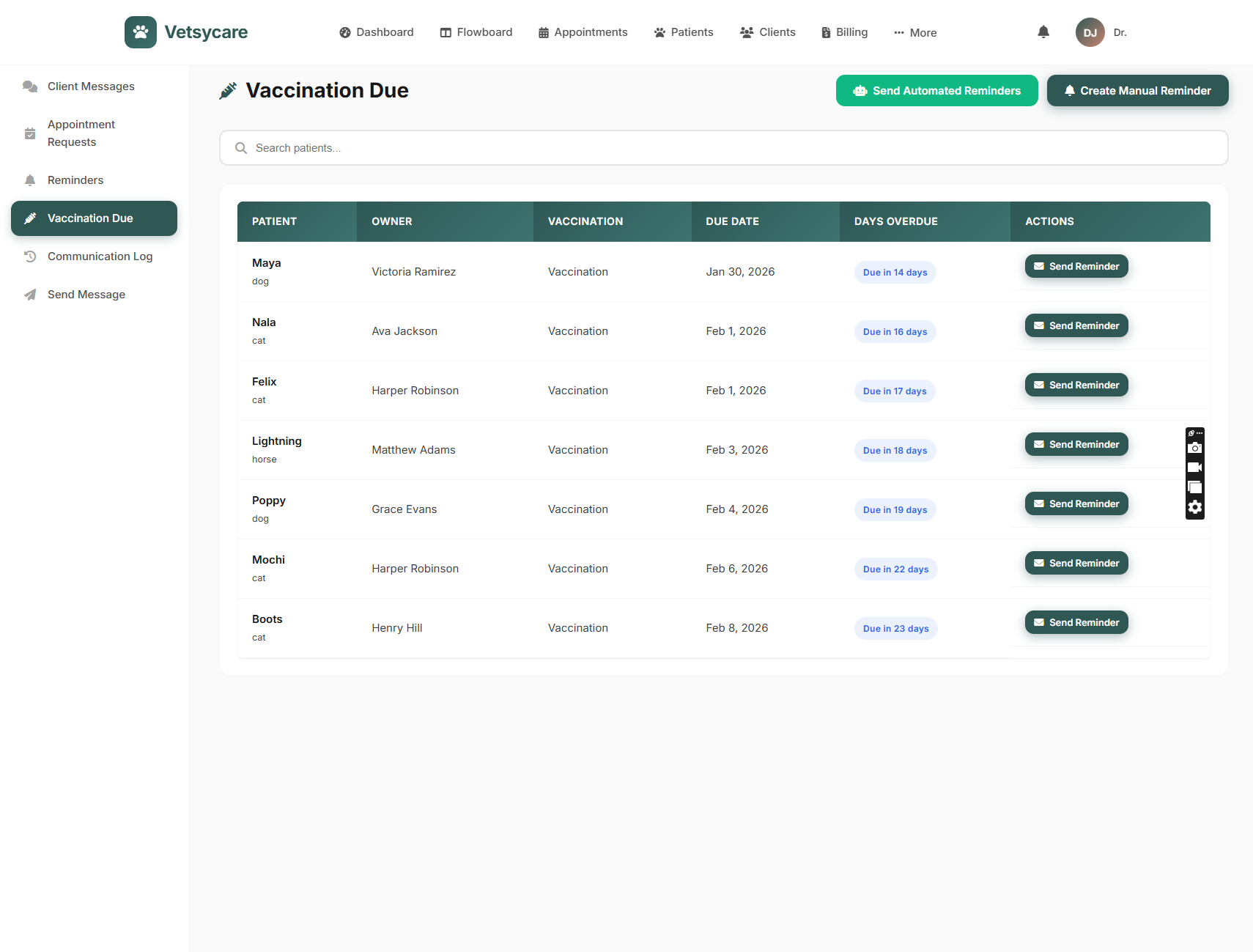
Modern veterinary practice management software handles much of this automatically:
- Automated multi-channel reminders at customizable intervals
- Confirmation tracking with follow-up workflows
- Online self-service scheduling for easy rescheduling
- Waitlist management with automated notifications
- No-show analytics identifying patterns and problem areas
- Client history flags for repeat no-showers
Reduce No-Shows with VetSyCare's Smart Scheduling
VetSyCare includes automated SMS and email reminders, confirmation tracking, online booking, and waitlist management—all designed to minimize missed appointments and maximize your schedule.
Start Your Free TrialQuick Implementation Checklist
Start reducing no-shows today:
- ☐ Enable automated SMS reminders (48hr, 24hr, 2hr)
- ☐ Implement confirmation requests
- ☐ Add easy reschedule links to all reminders
- ☐ Set up a waitlist system
- ☐ Track no-show rates weekly
- ☐ Identify high no-show time slots
- ☐ Create and communicate your cancellation policy
- ☐ Flag repeat no-show clients
Frequently Asked Questions
Should I charge no-show fees?
No-show fees can reduce missed appointments but may damage client relationships. Consider implementing fees only after multiple no-shows (e.g., third occurrence) and always offer a warning first. Many practices find that strong reminder systems reduce no-shows enough that fees become unnecessary.
How many reminders is too many?
Most clients appreciate 2-3 reminders. Start with 48-hour and 24-hour reminders. Add a same-day reminder only if no-shows persist. Always allow clients to opt out of reminders if they find them excessive.
What if clients say reminders are annoying?
Offer preference options: some clients prefer email, others text, some want fewer reminders. Modern PIMS allows per-client communication preferences.
How do I handle chronic no-show clients?
After 2-3 no-shows, have a conversation. Understand if there are barriers (financial, scheduling, transportation) and see if you can help. If the pattern continues, consider requiring deposits or credit cards on file for future appointments.